सहायता / पहुँच और नियंत्रण
यह पेज अभी अनुवादित नहीं है — अंग्रेज़ी पाठ दिखाया गया है।
The “Control” section
Voids after the kitchen, discounts, manual prices, closings without payment, abandoned orders and red flags.
The section gathers what usually gets lost between receipts: actions that look normal one by one but add up to a picture together.
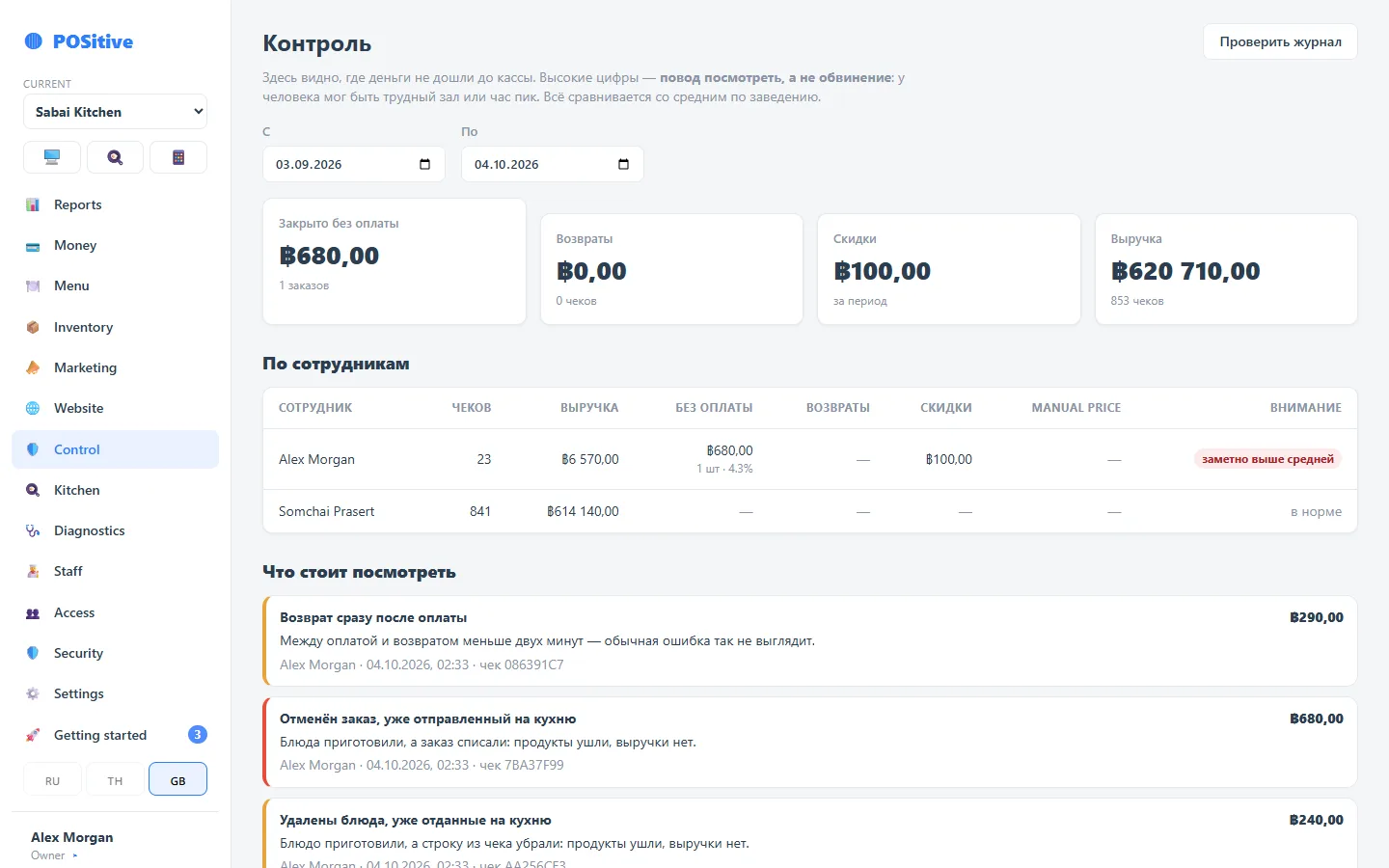
What to look at
| What | Why it matters |
|---|---|
| Voids after the kitchen | The dish has already been cooked — a direct loss. You see who and for how much |
| Discounts | Especially manual ones: who, how much, on which receipts |
| Manual prices | Items whose price was set by hand |
| Closings without payment | On-the-house items and written-off receipts with a reason |
| Refunds | Who, what, when and why |
| Abandoned orders | Entered, cooked — and never closed |
Red flags
The system highlights the unusual: many voids by one employee, regular shift discrepancies, discounts above the usual. This is not an accusation but a reason to look more closely.
How to investigate
- Open a period — usually a week or a month.
- Look at the totals: voids, discounts, closings without payment.
- Find who they concentrate around.
- Open the specific receipts and the event log — the sequence of actions is visible there.
- Talk to the person with the receipt and the time in hand, not a feeling.
Most often it is not theft
In the first months most “red” figures are learning: the cashier does not know how to void an item properly and does it the way they can. Investigating is necessary, but the conversation is better started with a question than an accusation.